
Essay: Some time when the river is ice, ask me what I've unlearned
The Preamble
(aka an essay I wrote in 2016)
“Some time when the river is ice ask me mistakes I have made. Ask me whether what I have done is my life. Others have come in their slow way into my thought, and some have tried to help or to hurt: ask me what difference their strongest love or hate has made. I will listen to what you say. You and I can turn and look at the silent river and wait. We know the current is there, hidden; and there are comings and goings from miles away that hold the stillness exactly before us. What the river says, that is what I say.” –William Stafford
2016.
Here’s to “writing from the heart and not hitting backspace until it feels safe again”.
This year I have learned that people’s true colours come out when faced with times of crisis, and that they will react with their strongest love or with their strongest hate. People are people; everyone is simply trying to protect their own truths.
Forgive them and move on.
I have learned that there will always be people that don’t understand you. There will always be people who disagree with you. But there will also be people that do understand, and though they might not agree, they will realise that your life choices are just that, yours. I learned that being a Christian does not, in fact, exempt you from the ability to be a colossal asshole, and that using the bible as a shield to justify saying hateful things is not love, it’s just being kind of a dick. Don’t be a dick.
But like I said, we all have our own truths, so forgive and move on.
I have learned that honour is inconvenient and absolute. I have learned that ‘freedom is not following a river. I also learned that freedom is following a river though, if you want to’. I have learned that you are always stronger than you think you are. Allow your curiosity to override your fear, and you will discover that the strength you are capable of is more than you give yourself credit for. Use that strength to pull yourself up, to pull yourself through.
I have learned that sometimes you have to work a little so that you can ball a lot (or that when life hands you lemons, you sell your grandma’s jewellery and go clubbing). I learned that your foosball skill level is at it’s peak after two beers.
I have learned that no matter where you are or what the circumstances might be, you are not alone. I have learned that there is a power in letting go, that you can only swim against a current for so long before allowing the river to take you home.
I have learned that there is an even greater power in allowing yourself to be vulnerable. I have also learned to cherish the people that allow you to be vulnerable without the fear of judgement.
I have learned that sometimes happiness is a choice, and that on some occasions you are allowed to choose happiness. I have learned that when the path reveals itself; don’t be afraid to follow it.
I have learned that your dreams are only as big as you allow them to be. I have learned that you should never say no to an opportunity to have coffee with someone that you can learn from (and you can almost always learn something from anyone you meet). I have learned that taking walks and drinking tea is good for you.
I have learned that sometimes the best thing you can do is to not overthink things. I have learned that at 24, it’s okay not to have all your shit together. I have learned that when someone asks “who are you really wanderer?” the answer you have to give no matter how dark and cold the world is, “Maybe I’m a king.”
Maybe I’m a fucking king.
2025 (nine years later)
The river was ice when I first wrote about it in 2016.
In true almost-mid-twenties fashion, I thought I had figured some things out. I wrote about honour being absolute and learning that sometimes happiness is a choice. I wrote about rivers and resilience, about forgiveness and foosball.
I wrote, "Maybe I'm a king."
And I meant it. I felt it. The power of declaring ownership over my own narrative was intoxicating.
Now almost a decade later, I stand by every word of that essay (you just know it was a Facebook post). But what I've realised since is that learning was only half the journey. The other half (the messier, more fascinating half) has been about unlearning.
The difference between learning and unlearning
There's something clean about learning. It adds. You discover a new truth, you absorb it, and you integrate it. You get to feel that little dopamine hit of knowing something you didn't know before.
Unlearning is different. It subtracts. It's about looking at something you've carried with absolute certainty (perhaps for decades) and saying, "Actually, I need to put this down now."
It's letting go of the safety bars on a rollercoaster while it's still moving (not that you’d ever catch me on an actual rollercoaster, mind you).
Unlearning as self-excavation
In 2016, I learned that your dreams are only as big as you allow them to be.
In the years since, I've unlearned the belief that my dreams need to be big at all.
What a revelation it was to discover that sometimes, smallness is precisely what we need. That contrary to every Instagram caption and corporate mission statement, not everything needs to be scaled, maximised, or optimised. That you don't need to be a king to be worthy.
This isn't about diminishing ambition. It's about excavating the layers of "should" that had calcified around my understanding of success.
A brief catalogue of abandoned certainties
Here is an incomplete list of things I've had to unlearn since writing that essay as a bright-eyed 24-year-old:
I've unlearned the need to be right. I wrote about how everyone is just trying to protect their own truths. Now I've realised that sometimes your truth is simply wrong, and that's not a moral failing. It's just being human. That real strength lies not in defending your truths but in being willing to revise them.
I've unlearned the belief that strength means soldiering through. Young me wrote about being stronger than you think. Old(er) me now knows that sometimes strength looks like saying, "I can't do this alone” or even "I can't do this at all."
I've unlearned the idea that I need to have my shit together by [insert any arbitrary age]. At 24, I wrote that it's okay not to have all your shit together, but there was an unspoken assumption there that eventually, I would have it all figured out. At 33, I now know that having your shit together isn't a destination but a series of moments, interspersed with spectacular periods of having absolutely no idea what you're doing (when the shit is literally all over the place). And that's not failure; it's just the rhythm of being alive.
I've unlearned caring what people think about me (mostly). This one has been liberation in its purest form. It happened somewhere around 30 (and is happening over and over every day): this magical ability to let my mask slip on purpose. To raw-dog my neurodivergence in the eyes of the world. To say things like "raw-dog my neurodivergence" and not immediately worry if it sounds unbecoming.
I've also unlearned any and all mathematical ability (though I was scraping the bottom of the barrel to begin with). This happened instantly as I left the school premises for the last time, like some force reached into my brain and extracted every bit of it I'd ever tried to memorise. Or actually, I recently saw a video of the (now late) Pope Francis at a bishop’s meeting where he yanked the tablecloth from the altar, leaving everything else perfectly standing. So maybe it was rather a cosmic Pope whipping all the maths out, leaving everything else intact. Bless him.
Freedom is not following a river (except when it’s)
In 2016, I quoted a line (from another William Stafford poem, “Freedom”) that now feels like my younger self reaching through time to tell me something important: "Freedom is not following a river. I also learned that freedom is following a river though, if you want to."
It seems I was already starting to understand the paradox: that sometimes the rules apply, and sometimes they don't. That wisdom lies not in discovering universal truths but in discerning which truths apply in which moments.
At 24, I was learning to swim against the current. At 33, I've unlearned the belief that I always have to. Sometimes, the most radical act of self-determination is letting the river take you home.
It's what it's
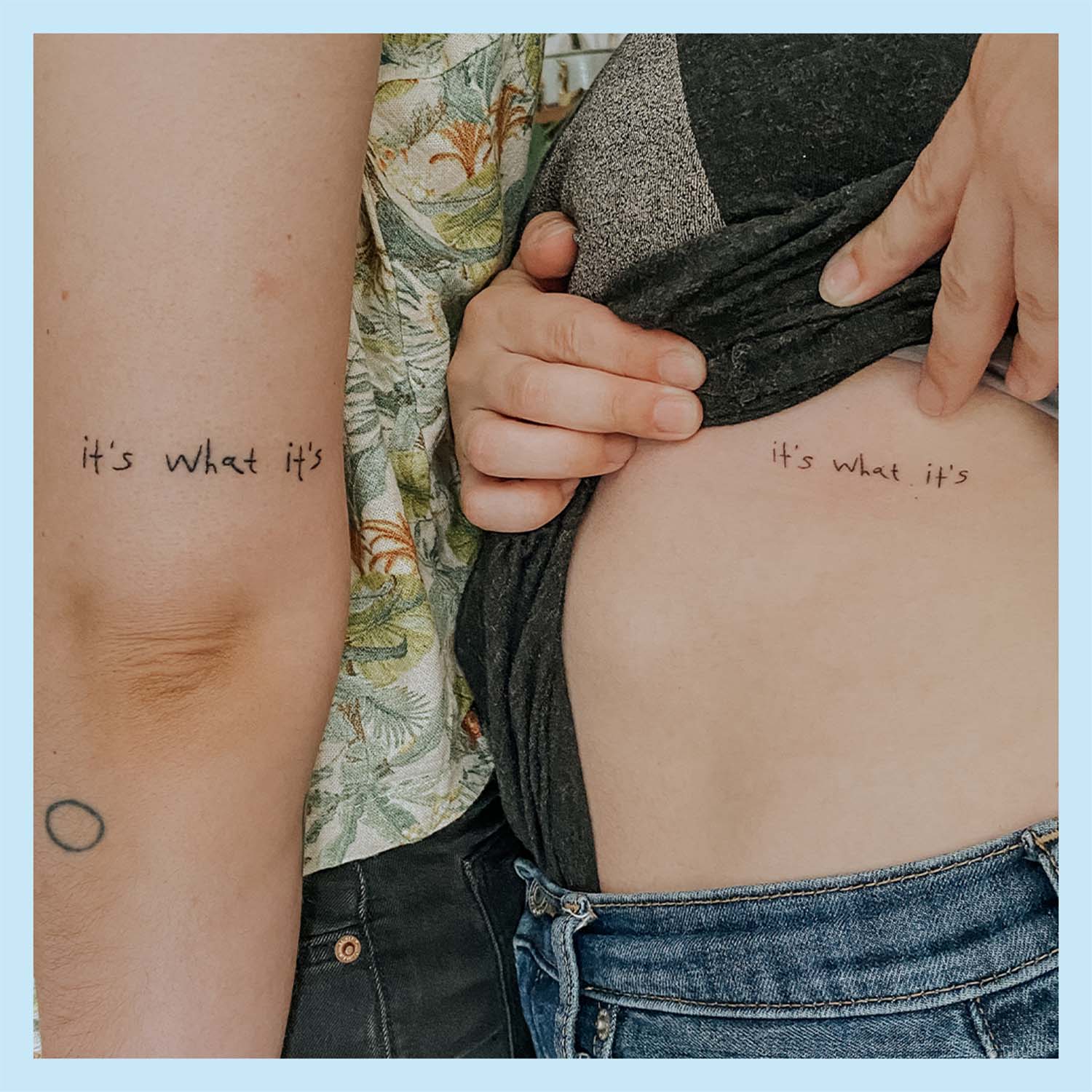
One of my best friends and I have matching tattoos bearing the beautifully absurd phrase "it's what it's." We are chronic believers in "it is what it is" because that's just life, you know? But we wondered how to make it stupider. To have it rebel against the constructs of grammar, of good sense, and maybe even the world itself.
That tattoo has become, surprisingly, my philosophical north star for unlearning. It reminds me not to take myself too seriously, even (especially) when dealing with serious things. It reminds me that sometimes, the most profound response to life's complexities is to shrug and say (with your whole chest), "It's what it's."
Not everything needs to make sense. Not everything needs to be figured out. Not everything needs to be earned or deserved or justified.
Unlearning as self-acceptance
In 2016, I wrote about finding strength and swimming against currents and choosing happiness.
All of those lessons still matter. But what I've unlearned since then is the belief that I need to constantly improve, optimise, and transcend my humanity. I've unlearned the idea that I'm a project to be completed rather than a person to be experienced.
There's a counterintuitive freedom in accepting that some days, you're just going to be a mess (like when you haven't washed hair in 11 days because the thought of water touching your scalp makes you want to throw up), and that it’s not a failure of character. That some days, the most productive thing you can do is absolutely nothing. That some dreams are worth pursuing precisely because they're small and attainable and bring you joy in their modesty.
At 33, I feel less like a king and more like a person. And that feels like progress.
The river now
So here I am, almost a decade after that first essay, standing by a river that is sometimes ice and sometimes water. The river says what it has always said, and I say what I've always said, but the meanings have evolved.
I've learned that unlearning doesn't mean the original lesson was wrong, just that it was incomplete. Or that it served its purpose and now needs to step aside for something new.
I've realised that you can only unlearn once you've learned, because dismantling requires something to have been built first.
I've learned that when Stafford wrote, “Ask me mistakes I have made. Ask me whether what I have done is my life", he was inviting exactly this kind of reflection. Not just on what we've built, but on what we've had the courage to deconstruct.
Some time when the river is ice, ask me what I've unlearned. Ask me how I've changed and how I've stayed the same. I will listen to what you say. You and I can turn and look at the silent river and wait. We know the current is there, hidden, the current of growth, of evolution, of becoming. The current that sometimes we fight against and sometimes we surrender to.
What the river says, that is what I say: that growth isn't just about what we add to ourselves, but also what we have been brave enough to let go of. That unlearning isn't failure. It's the most honest form of evolution.
And that sometimes, when faced with the sublime complexity of being human, all you can really say is “it's what it's.”
And mean it.